
Introduction
Imagine a university without boundaries. A campus that stretches across every city, town, and remote village. A lecture hall that exists in your living room, your study, or even under a tree in your courtyard. This isn’t a futuristic concept; it’s the reality that Allama Iqbal Open University, known to millions simply as AIOU, has been building for over five decades.
For countless people across Pakistan and beyond, AIOU isn’t just an educational institution; it’s a second chance, a ladder to a better career, and a promise that learning has no expiry date.
Whether you’re a young student in a rural area with no local college, a mother managing a household while pursuing a degree, a professional seeking an upgrade without leaving your job, or a retiree finally exploring a passion, AIOU has a place for you.
Let’s explore the story, the system, and the profound impact of this unique university.
What is AIOU? Breaking Down the Basics
AIOU stands for Allama Iqbal Open University. Established in 1974, it was Pakistan’s first open university and is now one of the largest in the world by student enrollment. The “open” in its name is the key to understanding its mission.
Unlike conventional universities with fixed schedules and physical attendance requirements, AIOU operates on the principles of open and distance learning. This means education is flexible, accessible, and designed to fit into your life, not the other way around.
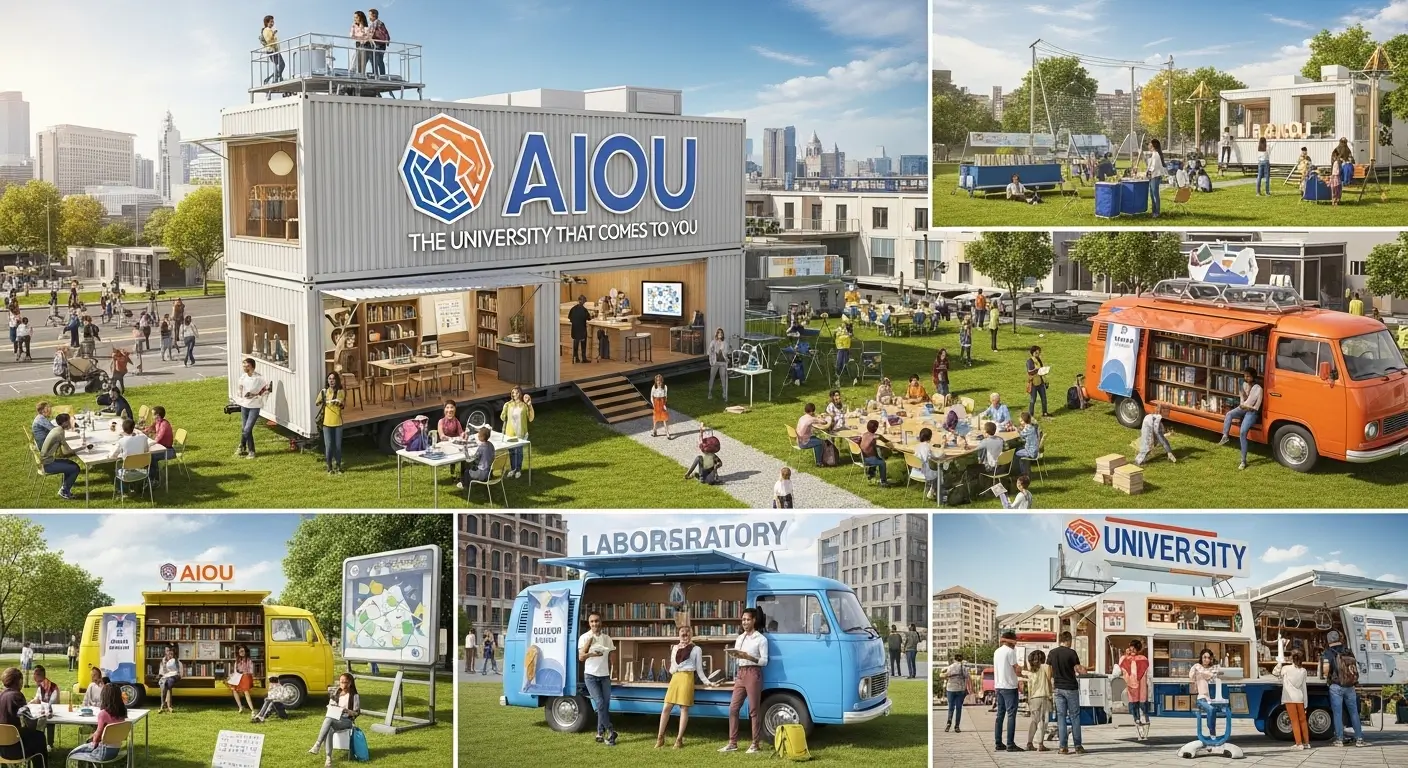
Think of it this way: instead of you going to the university, AIOU brings the university to you. It does this through a blend of printed course materials, radio and TV broadcasts, online resources, and a network of regional offices and tutors. Its foundational goal was—and remains—to democratize education, making it available to everyone, everywhere, regardless of their circumstances.
Key Facts at a Glance:
- Founded: 1974, in Islamabad, Pakistan.
- Namesake: Named after Dr. Allama Muhammad Iqbal, the philosopher-poet who inspired the Pakistan movement.
- Core Model: Open and Distance Learning (ODL).
- Student Body: Serves hundreds of thousands of students annually, from matriculation to PhD levels.
- Motto: “Education for All” – a principle it actively strives to live by.
The AIOU System: How Does It Actually Work?
The magic of AIOU lies in its well-structured system. It might seem complex at first, but it’s designed for clarity and student support. Here’s a step-by-step look at how an AIOU program typically functions.
1. The Admission Process: Open to All
Admission at AIOU is notably flexible. There are usually two admission cycles per year (Spring and Autumn). You don’t need to compete in ultra-competitive entry tests for most programs. Eligibility is primarily based on your previous academic credentials. You apply through their website or by visiting your nearest AIOU regional office, submit your documents, and you’re in. This openness is what shatters the first major barrier to education.
2. Your Study Package: The University in a Box
Once enrolled, you don’t get a list of textbooks to buy. Instead, you receive a comprehensive “study package” for each course. This package is the heart of the AIOU learning experience and usually includes:
- Course Books: Specially designed, self-explanatory texts written by AIOU’s own faculty. They are structured for independent study.
- Assignments: A series of Tutor Marked Assignments (TMAs). These are not just homework; they are a critical part of your final grade and your main point of interaction with your tutor.
- Schedule: A clear timeline telling you when to study which unit and when to submit your assignments.
3. The Support Network: Tutors and Regional Centers
You are not alone. AIOU assigns you a tutor for each course. This tutor is your academic guide. You can contact them with questions, attend optional tutorial meetings (often held on weekends at local centers), and most importantly, you submit your assignments to them for detailed feedback and grading.
This support is managed through a vast network of over 50 regional campuses and centers spread across the country. Whether you’re in Karachi, Skardu, Quetta, or a small town, there is likely an AIOU office within reach to provide administrative help, tutorial spaces, and a sense of community.
4. Assessment: Exams and Assignments
Your final grade in an AIOU course is typically a combination of:
- Assignment Marks (TMAs): Usually 30-40% of the total. This rewards consistent, ongoing study.
- Final Examination: The remaining 60-70%. AIOU conducts massive, centralized examinations across Pakistan at the end of each semester. You are assigned an exam center near your location.
5. The Digital Shift: Embracing Technology
While famously built on printed materials and postal services (earning it the affectionate nickname “the postal university”), AIOU has been actively transforming. It now offers:
- Online Admission and Results: Drastically simplifying processes.
- AIOU Aaghi LMS: A dedicated Learning Management System where students can access digital course materials, videos, and sometimes live sessions.
- Radio and TV Broadcasts: AIOU’s own broadcast channels, such as AIOU TV, offer educational content, lectures, and discussions, catering to learners without stable internet access.
Who Studies at AIOU? The Diverse Faces of a Nation Learning
The student profile of AIOU is a beautiful cross-section of Pakistani society. It shatters the stereotype of the “typical” university student.
1. The Career Advancers: Government employees, teachers, and professionals from various fields who need a formal degree or higher qualification for a promotion or a career shift. For them, AIOU provides a way to study while earning.
2. Women, Especially Homemakers: AIOU has been a revolutionary force for female education in Pakistan. Women who may have had to discontinue their studies due to marriage, family responsibilities, or social constraints can pursue degrees from the safety and convenience of their homes. The numbers speak volumes: women consistently form a very significant percentage, often the majority, of AIOU’s student body.
3. Students from Remote and Rural Areas: For a young person in a village with no college for miles, AIOU is often the only viable path to a bachelor’s degree. It bridges the glaring urban-rural education gap.
4. The Passion Learners: Retirees exploring history, young artists studying literature, or individuals simply pursuing knowledge for its own sake. The low cost and flexibility make lifelong learning a reality.
5. Prison Inmates: In one of its most socially impactful programs, AIOU provides education and skill-based courses to inmates in prisons across Pakistan, offering hope and a path to rehabilitation.
The Academic Spectrum: What Can You Study at AIOU?
The range of programs at AIOU is vast, catering to almost every interest and career goal. It’s not just arts and general education; it offers rigorous professional programs as well.
- Matriculation and Intermediate (FA/FSc): Providing a crucial second chance to complete school-level education.
- Bachelor’s Degrees (BA, BCom, BEd, BS): Across disciplines like Education, Business Administration, Computer Science, Social Sciences, and Languages.
- Master’s Degrees (MA, MSc, MEd, MBA): Including popular programs in Urdu, English, History, Pakistan Studies, Education, and Management Sciences.
- Postgraduate Diplomas and Certificates: Short, focused programs in areas like Teaching, Journalism, or Library Science.
- PhD Programs: AIOU is a major hub for doctoral research, particularly in fields like Education and Social Sciences.
- Skill-Based Vocational Courses: From cooking and dressmaking to electrical work and mobile phone repair, these courses are designed for immediate economic empowerment.
The Challenges and the Road Ahead
No institution is perfect, and AIOU faces its own set of challenges, often voiced by its students.
- Administrative Delays: The sheer scale can sometimes lead to slow processing of admissions, result declarations, or degree issuance.
- The Digital Divide: While moving online, ensuring seamless access for students in areas with poor internet remains a hurdle.
- Perception of Quality: Despite its rigorous systems, some in the job market still hold a bias against distance learning degrees compared to traditional ones—a stigma AIOU continuously works to overcome through quality assurance.
- Tutor Consistency: The quality of the tutoring experience can vary, depending on the individual tutor.
However, AIOU is actively addressing these. The digital transformation is a top priority. The university is strengthening its internal systems and increasingly collaborating with international open universities to benchmark its quality.
Why AIOU Matters: The Bigger Picture
The impact of AIOU goes far beyond individual degrees. It is a pillar of national development.
- It Promotes Social Equity: By being affordable and accessible, it is perhaps Pakistan’s greatest tool for creating a level educational playing field.
- It Empowers Women: It is one of the largest engines of female higher education in the country, directly contributing to gender empowerment.
- It Fuels the Workforce: It upskills the existing workforce and prepares new entrants, contributing to the national economy.
- It Believes in Second Chances: It embodies the philosophy that it’s never too late to learn and improve your life.
Is AIOU Right for You? A Practical Checklist
Considering AIOU? Ask yourself these questions:
- Do I need flexibility above all else? (If yes, AIOU is ideal.
- Am I self-motivated and disciplined enough to study independently? (This is the key to success here.
- Is my goal to gain knowledge and a recognized qualification for career advancement? (AIOU excels here.
- Do I lack access to a conventional university due to location, finances, or life commitments? (Then AIOU is your solution).
If you answered yes to these, then AIOU might be your perfect educational partner.
Final Thoughts
Allama Iqbal Open University is more than an institution; it’s a promise. A promise that your address, your bank balance, your age, or your responsibilities are not barriers to your right to learn. It is a testament to the vision that education should be a public good, not a privileged commodity.
The journey through AIOU requires dedication and self-reliance. It won’t give you the typical campus life of hostels and cafeterias. But what it will give you is something profound: the power to shape your own future on your own terms. In the story of Pakistan’s education, AIOU is not just a chapter; it is a volume all its own, continuously being written by the millions who walk its unique, open path.